2013
Another year, another iOS, the alarm UI is still broken
Last year I wrote about the broken UI for the alarm feature of iOS 6’s clock app. That post was really a follow-up to my tweet from the year before noting that iOS 5’s clock app had a broken alarm UI. Well, this year iOS 7 launched to much fanfare but the UI is still broken—though slightly improved.
Fundamentally, the problem I have is the inability to determine whether or not an alarm is currently snoozed. I run into this issue every single day (well, actually, it happens less and less because I’ve been training myself to wake up at the right time without an alarm—that’s a whole other blog post—but I have to believe this affects a huge number of iOS users on a daily basis). The scenario unfolds like this:
My alarm goes off at precisely 7:06 AM and I blindly reach over to my bedside table, fumbling with unknown objects in the preconcious state that makes me only vaguaely capable of operating my hands. Finally I find the familiar feel of that chamfered aluminum and cold glass, grasp the phone reflexivly and click the lock button once. I don’t even have to open my eyes. The alarm is now snoozed.
I fight the gravity of sleep, attempting to rouse myself from that preconcious state into someone more capable of starting the day. After what feels like hours of fighting my way back from the precipice of unconciousness interspered with several real and possibly imagined snoozings of the alarm, I sit up. I am awake.
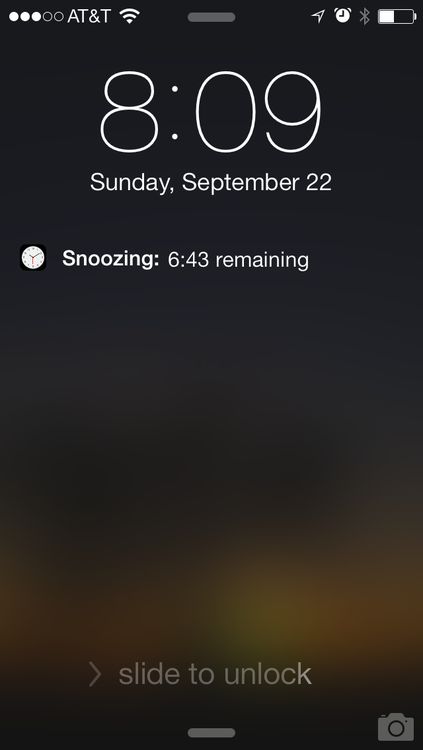
As has become the routine in this modern age, I pick up my phone again to check Email/Twitter/Facebook. I press the home button once and here I find the only positive change to iOS 7’s alarm UI. Where before there was no indication that I had snoozed an alarm, I am now presented with a countdown at the top of my lockscreen notifications indicating that I have 6 minutes and 43 seconds before the alarm goes off again. Progress!
_
The timer is gone!
I swipe to unlock, open the Clock app and look at my alarms. Everything is still set.
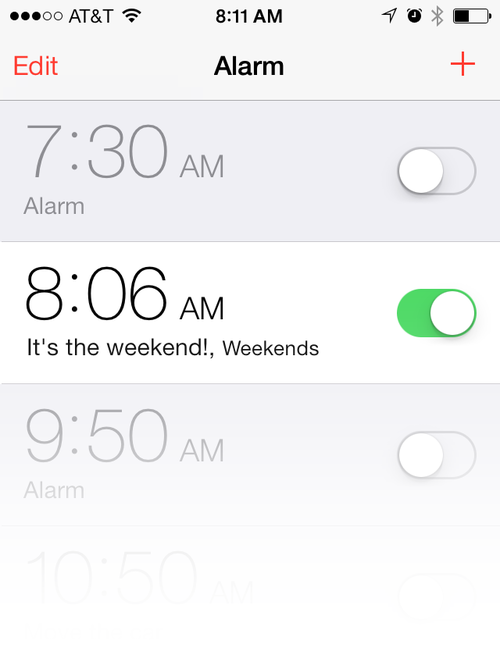
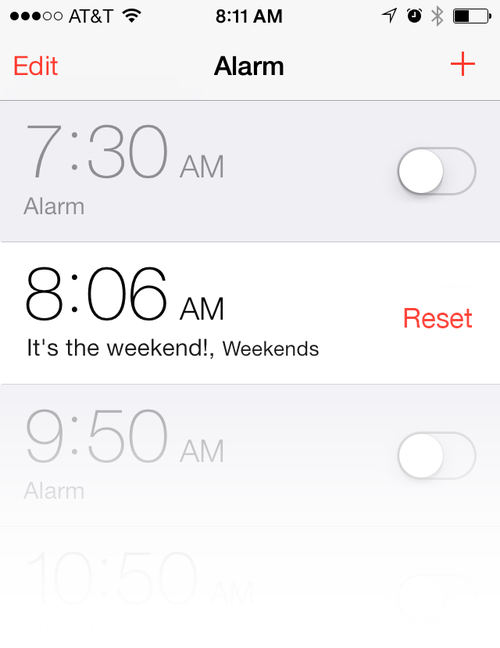
(2) An alarm that is currently snoozed should show a reset button rather than the standard switch. Tapping the reset button would return the alarm to the appropriate state. If it’s a recurring alarm the switch is shown again in the on position. If it’s a one-time alarm, the switch is shown again in the off position.
Here’s hoping iOS 8 takes another step forward. In the meantime, I’ve now surpassed last year’s record for using the word “snooze” in a single document.
_
On the one hand i love driving im passionate
Guns, Germs, and Steel
All I could think about while reading this book is that a much more appropriate title would be “Plants, Animals, and Geography.” Alas, I bet the publisher would have vetoed such a bland choice. In the end, those are the three key factors that influenced the long term success of every civilization on the planet. Ultimately, yes, guns, germs, and steel allowed one civilization to “engulf” another but the reason the dominant civilization had guns, germs, and steel in the first place was due to prehistoric luck. It found itself with plants that were amenable to farming, animals amenable to domestication and geography that enabled the extension and expansion of the young civilization when it was ready.
History unfolded the way it did, paraphrasing Einstein, not because any one civilization has (or had) smarter people than the others. But rather, the aforementioned plants, animals, and geography, provided a sort of head start to the civilizations that, in hindsight, appear “better” and they were able to spend more time working on the problems, challenges and technologies that ultimately developed into guns, germs, and steel. This is a reassuring conclusion. It means that if we could teleport prehistoric hunter-gatherers from one region to another we would still find that a civilization based in Europe ultimately engulfs much of the world. And more importantly, this conclusion renders racism that proclaims the superiority of one genetic group over another baseless.
Following the high-level but thorough analysis of how the modern world came to be, Diamond couches his conclusions a bit. He recognizes that there are some notable outliers that don’t fit the pattern he describes. China, in particular, which stepped backwards from its position as technology leader suggests that plants, animals, and geography were only a starting point. There were and still are a multitude of factors that impact the longterm success of a civilization.
After spending quite a bit of time on this book (it’s dense, dry and long) I’m left wondering about the utility of this knowledge. The author’s conclusions about racism are heartening and the discussion of technology/idea diffusion seems relevant to the distribution of information in large organizations—something he talks about a bit in his second edition follow-up. Something to ponder…
Cutting for Stone
First book in a while that I didn’t enjoy and left me with negative feelings. Things did not go well from the very beginning: the story could have easily proceeded without the interminable first 120 pages—nothing happens that we don’t already know about. And I while I grant that it is a book centered on the lives of surgeons (something I did not know when it was recommended to me), some of the surgery scenes veer from detailed descriptions to unnecessary gore. I also never felt particularly good about the protagonist: he is portrayed often as weak, or at least always uncertain, and yet this same person is strong enough to flee a war-torn country and put himself through medical school. It just didn’t add up. In the end, I feel like the author started with the idea of the story’s climactic scene (no spoilers!) and then wrote the narrative in reverse to fit that unique sequence. Maybe that’s what all authors do, but here it felt obvious. Do not recommend.
The Early History Of Smalltalk
Reading about the invention of object oriented programming feels a bit like reading about the invention of the wheel. Not that I’ve read anything about the invention of the wheel, but of course that’s because I take the wheel for granted. I guess OOP sometimes feels like the programming equivalent of the wheel: I suppose I’ve also taken object oriented programming for granted. To be reminded of the fact that someone had to sit down and develop the kernel of that idea and see it through into useable system was refreshing and a little frightening.
An engineering education requires reading a huge amount of technical literature but very little of what’s read is a first-person historical narrative and that made reading Alan Kay’s account of Smalltalk’s development particularly engaging. A strange byproduct of the technology industry’s rapid pace of advancement is that we rarely have time or inclination to read historical technical documents. We never seem to devote time to the process of how the technologies we use were developed.
(Github)