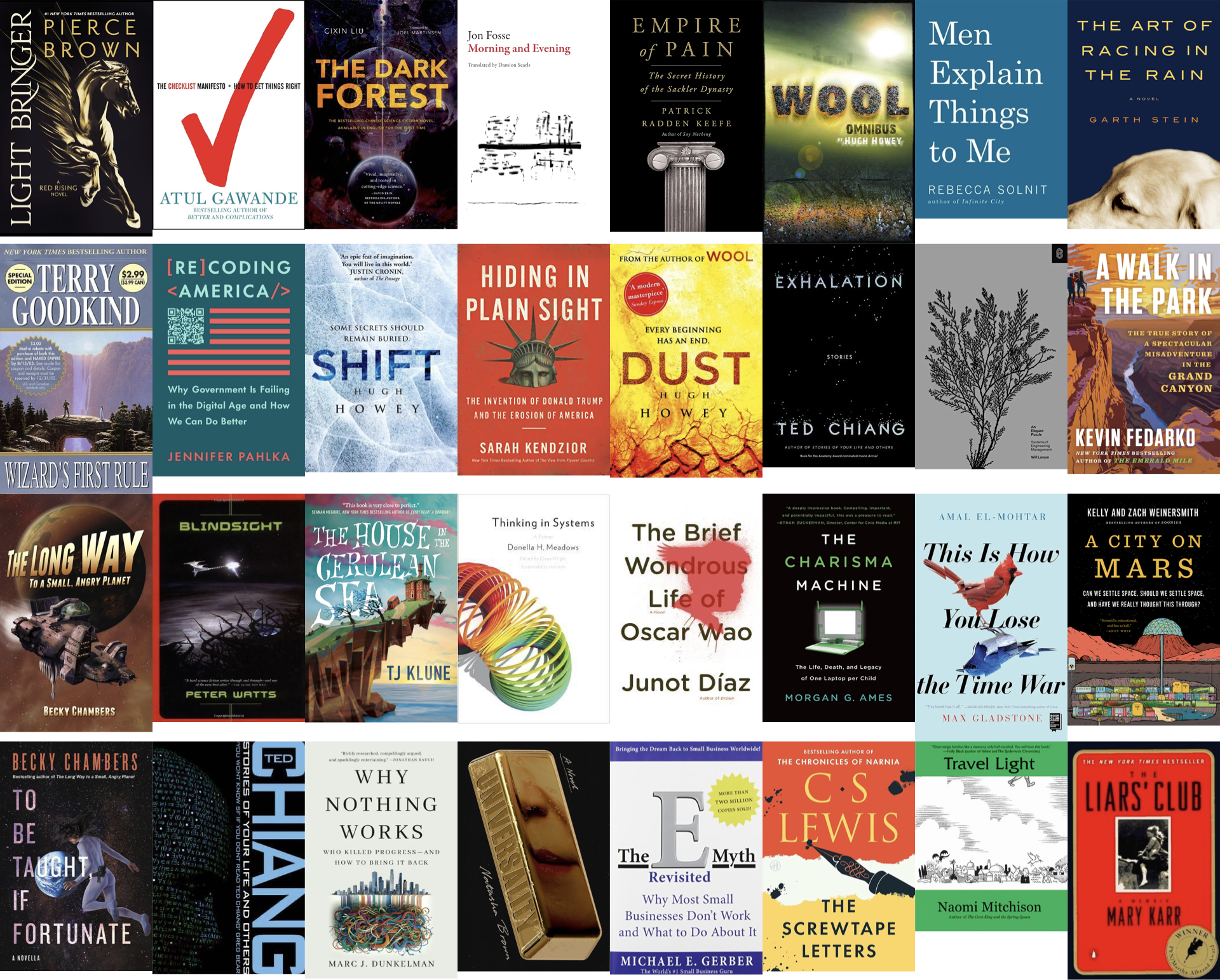
What I read in 2025
This year I (finally) found my way to a Kindle and the library in my phone. Both of those things made books and reading more accessible to me than I would have expected. They definitely helped with my doom scrolling (though cutting out most social media half way through the year made a big difference too).
Only downside is I don't have a shelf full of tangible artifacts1 to remind me about the ideas I encountered through these books. We'll have to wait and see if that affects long term retention.
Light Bringer
So much. But like, maybe, too much.
Checklist Manifesto
I never want to have surgery. Can it really be that checklists in surgery are an invention of the 21st century and still aren't universally mandated? That is shocking to me.
The Dark Forest
Now it gets interesting.
Morning and Evening
Different. Warm.
Empire of Pain
Fuck.
Best non-fiction of the year, but, yeah, people are the worst.
Wool
Enjoyable but thin. The TV show, while slow, is a decidedly richer world.
Men Explain Things to Me
It is, in fact, a slippery slope from "mansplaining" to sexual assault.
The Art of Racing in the Rain
This is a gorgeous story. Hard but warm. Particularly enjoyable for anyone who has had the good fortune to find themselves going fast on a race track.
Wizard's First Rule
Enjoyable, but didn't really land for me. A reminder that I am generally not a fan of fantasy.
Recoding America
A reminder that government works. A reminder that in the modern world you cannot separate policy from implementation.
And yet, software cannot be a literal implementation of policy.
I also loved this section on project management. Planning only takes you so far:
When the GetCalFresh team made these choices, they were practicing a discipline called product management. It is frequently confused (especially in government) with project management, but the two are distinct, and the difference between them is crucial. Project management is the art of getting things done. Product management is deciding what to do in the first place—and also, as in the case of the benefit screeners, deciding what not to do. If you collect hundreds of formal requirements and just start building software for all of them, you’ve generated a whole lot of work for skilled and dedicated project managers, but you haven’t made any real choices. That’s how you end up with a 212-question SNAP application, or a website that works only on computers in your building, or a system so complex it takes seventeen years to learn.
Project managers are all over government. Their sheer numbers became clear to me when I was working at the White House in the months after the launch of healthcare.gov. I found myself in touch with a lot of federal IT managers, and I noticed that most of them had something after their name in the email signature: PMP. I’d spent fifteen years in the consumer technology world but I had never seen that abbreviation before, so I looked it up. It stands for project management professional, and you can put those letters after your name only if you’ve completed an accredited course of study (traditionally on waterfall principles) and passed a certification exam. In the civil service, many promotions and raises rely on getting this certification. It can be hard to climb the career ladder without it. No wonder there are so many PMPs.
On the other hand, product managers in government software development have been essentially nonexistent. Between 2015 and 2020, in a federal workforce some two million strong, only seven people had “product manager” or “product management” in their job title.3 There are lots of people like Natalie trying to do what product managers do, but they are frequently seen as rocking the boat. It’s not what their job is supposed to be. They do it through sheer force of will.
I met one IT project manager in state government who was acting quite a bit like a product manager, fighting the same kinds of fights that Natalie had. She had gone through the PMP training but hadn’t bothered to take the certification test. She didn’t find the coursework very useful. “It’s all about the planning, mostly at the beginning of the project,” she said. “And then tracking the requirements.” What about skills like reducing the requirements, the way Natalie had managed to get nine definitions of a group condensed into two? “Oh, no. They don’t teach that,” she told me.
Shift
Oh, so much better than the first book! An in intriguing and genuinely plausible backstory to the world described in Wool.
Hiding in Plain Sight
It's a good book. A reminder of how ashamed, aghast, appalled we should be that this man is president. The piece that's missing is why, despite overwhelming evidence of his utter incompetence, people find him compelling2.
Dust
A satisfying conclusion and you should read the short stories at the end. The whole series goes hard, but the short stories take it up a notch.
The astounding hubris.
And it feels relevant and allegorical to the present where a group of radicals are dismantling the institutions and traditions of the present world because they think they can design something better from scratch. Monsters.
Exhalation
Thought-provoking. Warm.
An Elegant Puzzle
A re-read, better the second time. I had forgotten how much of the author's language had seeped into my day-to-day vocabulary. Re-reading was refreshing and validating.
A Walk in the Park
Really great. Epic, but also encouraging.
The Long Way to a Small Angry Planet
Quite good.
Blindsight
Hard to read, but solid premise.
The House in the Cerulean Sea
Warm and cozy.
Thinking in Systems
Really good. Puts into words lots of things that one feels like they can develop an intuition about. Has one big flaw: PID.
The Brief Wondrous Life of Oscar Wao
The language is slick, decidedly cool, but the plot isn't compelling for me.
The Charisma Machine
Excellent work challenging preconceptions about learning with computers. Pairs and contrasts well with Mindstorms.
This Is How You Lose the Time War
Not what I expected. A kind of science fiction love letter.
A City on Mars
Less compelling than I expected. It's gonna be hard, yeah. Necessity is the mother of invention and all that.
To Be Taught, If Fortune
Read A City on Mars and you'll say, yeah it makes no sense to travel the stars. Read this and you'll yearn for it.
Best fiction of the year.
Stories of Your Life and Others
Not as many hits as Exhalation, but a couple of good ones.
Why Nothing Works
Really good. Using your power for good requires using your power, not diluting it.
Universality
Decent writing, but whatever the point was, I didn't connect with it.
The E-myth Revisited
Good advice delivered poorly.
The Screwtape Letters
I think there are clever points made, but the delivery mechanism makes them really hard to read.
Travel Light
A (meandering) reminder that we should not hold too tightly to what we have.
Liar's Club
Vivid and lovely writing, but hard to relate.
-
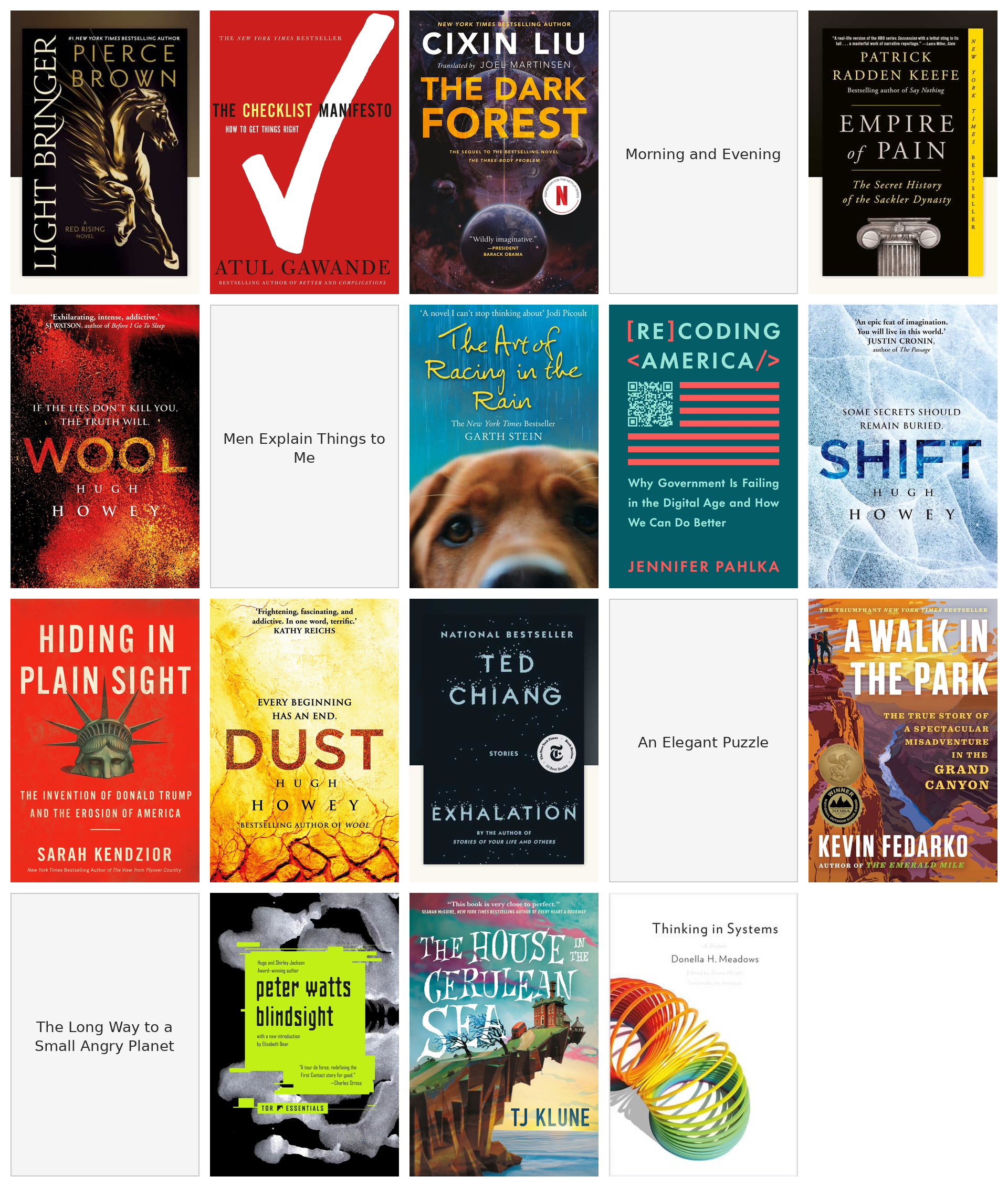
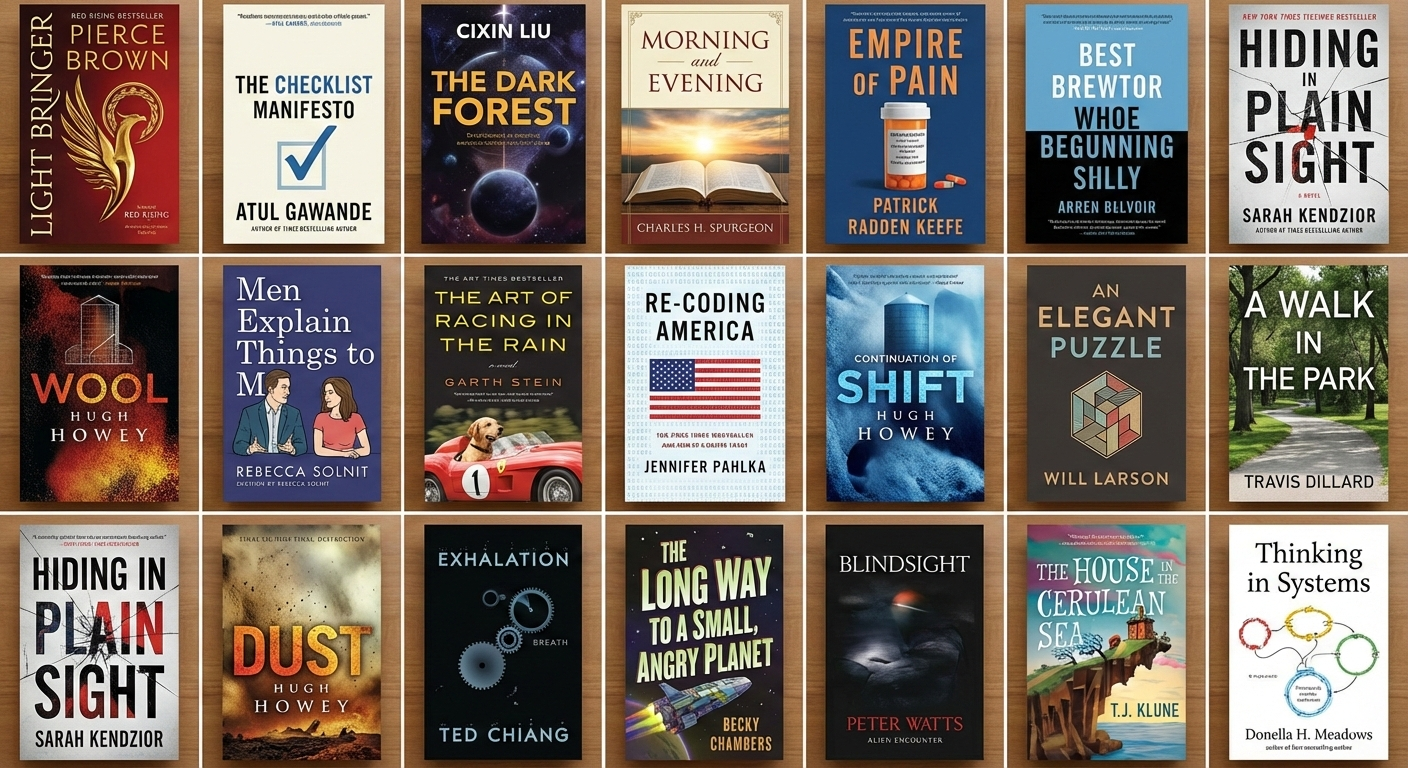
As an amusing aside, towards the end of 2025 I thought creating this image of book covers seemed like an ideal task for an AI agent. Take this list of books from my text file, go fetch cover images, and assemble a composite of all the covers together. Here's the exact prompt I fed to both Google Gemini and ChatGPT: Retrieve cover images for the following list of books and compose them into a grid in a single composite image. ChatGPT thought for over 25 minutes (!) and produced this image of covers and Google Gemini responded almost instantaneously with this image of covers. I ran this experiment before I had finished all the books of 2025, but it is both amazing that I can task a computer to do this sort of work with simple natural language and utterly baffling to see the ways in which these systems fail (I did not read Best Brewtor Whoe Begunning Shlly by the famous Arren Belvoir). ↩
-
I do like this hot take though: stupid people need a champion. ↩