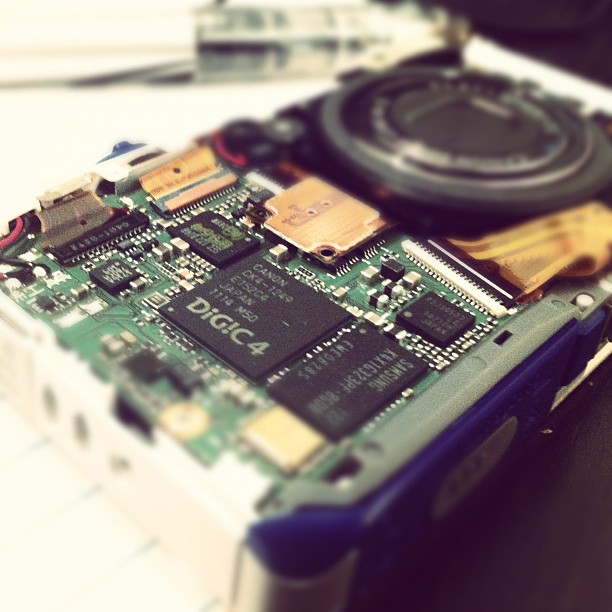
Micro machine taken with instagram
[

](http://instagr.am/p/KEIeWIJyzE/)
[

](http://instagr.am/p/KEIeWIJyzE/)
[

](http://instagr.am/p/JA2hooJy5k/)
What are the components of speeches, presentations, and lectures that transcend individuals, place and time to cause audiences to be, not just interested, but enthralled, inspired and motivated by the information being delivered to them? Nancy Duarte answers that big hairy question in Resonate. I won’t say that she completely nails it, but several of her points have really stuck with me. Foremost among them: the idea that the most successful presentations engage their audiences by contrasting what is and what could be. Apparently, we, as humans, are hard-wired to respond to contrast in all forms and every time a presenter compares the dilapidated present to the shiny bright future, something in our brain tells us, “Hey! Wake up! This could be really important!” and we pay attention. Nancy goes on to explain quite a few different methods for creating contrast (different types of media, facts and stories, songs and prose) and she also covers some of the more obvious aspects of presentation development. The section on structure, struck me as the weakest section of the book. Perhaps if you’ve never once tried to communicate a big idea you might find value here, but the author’s insights seemed to be lacking a bit in this section. Overall, the book is a short read and worth the small time investment for anyone looking to up their communication skills.
I’m fascinated by the amount of time and energy NASA spends developing robots for missions that are all fundamentally limited by the exorbitant cost of leaving earth’s gravity well. If we could reduce the cost of getting off this rock by a power of 10 or 100, we could alter the commercial space flight ecosystem so dramatically that these kinds of robots would be commonplace. Suddenly, they would all have a purpose and there would be real demand for their capabilities, not just the manufactured demand of NASA research scientists.
Yes, that rule 34. I thoroughly enjoy Charles Stross’ ability (and confidence) to extrapolate the near future consequences of today’s technology trends. This ability makes for a wonderfully fast-paced novel that, while light on plot, is filled with delicious and delightful references to geek culture. From 3D printers to AI run amuck, Rule 34 offers an intense glimpse at a future ruled by technology without the typical boring and tedious exposition: if you’re not up to date on modern geek culture, fully 75% of the references will be lost on you. And while the plot, overall, feels like a watered-down version of a classic Tom Clancy international crime syndicate / espionage thriller, on the whole Rule 34 is quite a good read.
[

](http://instagr.am/p/e-nCF/)
I generally enjoy the observations, insights, and inspiration that Seth Godin offers daily on his blog, but We Are All Weird doesn’t feel like his strongest work. If you’ve been anywhere near Internet culture in the last few years, you can easily think of 10 trends that support his primary thesis: mass anything is becoming a thing of the past. The barriers of entry to a huge number of industries have dropped so low that anyone can form the beginnings of a successful business with a minimum of investment. Those businesses can be successful by creating products that cater to a narrow niche of customers rather than the broad masses. The definition of success might differ a bit in this world of weird, but in general this is a positive trend that offers enormous opportunity for those who seek it.
That said, Godin fails to explore the potential downsides of this new paradigm. Weird can be great but it also has dark sides and the lack of that discussion in Godin’s book weakens his argument. If it is ever-easier to find the positive things that interest us, surely it is also ever-easier to find the negative things that interest us. Mass had the great benefit of building consensus by decree. Weird has the potential to fragment consensus irreparably. As we become more invested in niche communities, we may find that we are exposed to fewer and fewer uncomfortable ideas. The result is an insular population caught up in their own weirdness and whose weirdness is only ever reinforced. Weird may be a boon for marketers, but for a society that requires consensus to progress, it has the potential to be a significant obstacle.
[

](http://instagr.am/p/WB6gK/)
This isn’t a bad book, but the author’s observations shouldn’t be a surprise to anyone: the best companies are great because the people who run them are passionate about the products they produce. That’s not the intended point of the book of course, the intent is to show that the success of these companies and their products stems from their design processes and design cultures at the core of the organizations. But the only reason that design can be central to these businesses is that the leadership teams have made a commitment to produce things that they themselves desire. And rather than making compromises to stay on budget or meet arbitrary deadlines, the managers (and most frequently it’s the founders) of these companies opt to redouble their efforts to manufacture something great.
[

](http://instagr.am/p/VSfKh/)